Key features
- Client–server networking model — a dedicated server binary handles authoritative game state while clients connect independently, enabling persistent hosted servers and mid-game joins.
- Up to 255 players per session — the engine supports far beyond vanilla Doom's four-player ceiling, as documented in the GitHub repository.
- Cross-platform binaries — official release packages for Windows, macOS (universal binary), and Linux are distributed with each release.
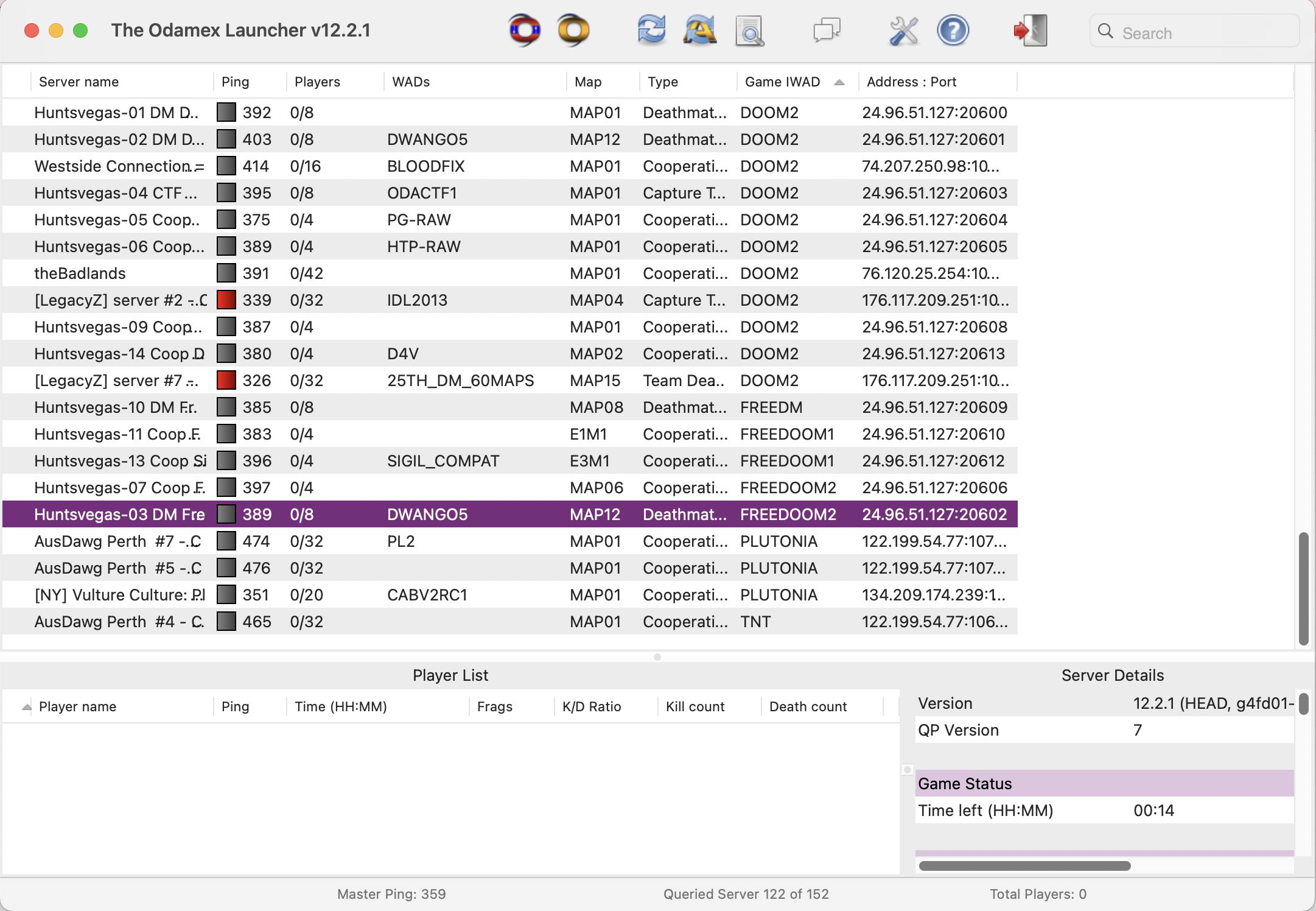
- Graphical server browser (Odalaunch) — a built-in launcher lets players discover, filter, and connect to public servers without manual IP configuration.
- CSDoom/ZDoom 1.22 lineage — based on CSDoom 0.62 by Sergey Makovkin, itself derived from ZDoom 1.22, providing a proven multiplayer foundation.
- GPL-2.0 open-source license — full source access with copyleft protections, enabling community contributions and transparent development.
- Dedicated server binary — headless server process suitable for always-on hosted game environments without a graphical interface.
- Active 12.x development series — the current release, 12.3.0, is a maintenance update ahead of the next major milestone, version 13.0.0.
What is Odamex?
Install Odamex and the first thing you’ll notice isn’t the engine — it’s Odalaunch, the bundled server browser, putting the multiplayer side of the port front and center. You may find that many listed servers are quiet, but that’s part of the current Odamex experience rather than a limitation of its underlying design. Built as a client–server platform for competitive and co-op Doom, Odamex includes a dedicated odasrv binary, supports up to 255 players per session, and offers cross-platform releases for Windows, macOS, and Linux. For players who already have a community, league, or specific server in mind, that infrastructure makes Odamex a straightforward choice; for someone hoping to open the browser and immediately find a busy pickup game, the smaller active player base means you may need a little patience.
Lineage and technical foundations
Understanding Odamex requires tracing its code ancestry. According to the project’s own GitHub repository, Odamex is based on the CSDoom 0.62 source code, originally created by Sergey Makovkin. CSDoom itself was derived from ZDoom 1.22, the early-era ZDoom release authored by Marisa Heit before ZDoom evolved into the feature-rich engine known today. That heritage gives Odamex a peculiar place in the family tree: it shares a common ZDoom ancestor with ports like GZDoom, yet its development path diverged entirely toward multiplayer infrastructure rather than renderer modernization or scripting extensibility.
The consequence of that lineage is that Odamex preserves a relatively conservative renderer compared to ports like GZDoom or Zandronum — it is software-based and closely aligned with the classic Doom aesthetic. That said, on the modding and mapping side, Odamex has grown considerably more permissive over time: it now supports most Boom and MBF mapping features, DeHackEd/BEX/DEHEXTRA patches, MBF21 thing flags, and — as of version 12.0.0 — full DSDHacked support, which allows it to run modern mods such as Eviternity II and Legacy of Rust. What it does not support is the UDMF map format used by some GZDoom/Zandronum-era projects, since Odamex’s editing feature set tops out around ZDoom’s Hexen-format and MBF21-era extensions rather than adopting UDMF.
Multiplayer architecture
The official Odamex website describes the port as one that “allows players to easily join servers dedicated to playing Doom online.” That framing — easily join — captures the central design tension Odamex resolves. Classic Doom’s original network code required players to be on the same local network segment or to manage complex peer-to-peer connections. Odamex adopts a client–server model, meaning a dedicated server binary handles game state while clients connect to it independently. This architecture enables persistent servers, spectator modes, mid-game joins, and server browsers that were simply unavailable in vanilla Doom.
The GitHub README for the project notes support for up to 255 players in a single session, a figure that illustrates just how far the multiplayer infrastructure extends beyond vanilla Doom’s four-player limit. In practice, servers hosting competitive deathmatch or cooperative play rarely approach that ceiling, but the technical ceiling demonstrates that Odamex was engineered for scale from the ground up rather than bolted onto a single-player codebase as an afterthought.
Odamex ships as a suite of binaries rather than a single executable. A client binary handles rendering and input, a dedicated server binary (odasrv) manages game logic and networking without a graphical interface, and a launcher utility — the Odalaunch application — provides a graphical server browser so players can discover and connect to public games without memorizing IP addresses or relying on external web directories.
Cross-platform distribution
From its earliest public releases, Odamex targeted the three major desktop operating systems. The official site and GitHub repository both confirm availability on Windows, macOS, and Linux, with Linux builds also distributed through Flathub. The macOS builds are distributed as universal binaries, providing native support across Intel and Apple Silicon hardware without requiring Rosetta. That breadth of platform support matters disproportionately for a multiplayer-focused port: a server operator running Linux and a player on Windows both need first-class binaries, and Odamex provides them without requiring players to run an emulation layer or build from source.
The project’s build system has evolved alongside these platform targets. The 12.x release series introduced a requirement that building the internal odamex.wad resource now depends on Python (minimum version 3.8) rather than the older Deutex toolchain, as noted in the release notes. This shift reflects a broader modernization of the build pipeline without changing the runtime experience for end users who download pre-built binaries.
The 12.x release series
The 12.x series represents the current development cycle. Odamex 12.0.0, subtitled “The DSDHacked Update,” was announced as the next major version of Odamex, featuring lots of bug fixes, quality-of-life changes, and — most notably — full DSDHacked support.
The subsequent 12.1.0 minor release addressed issues discovered after 12.0.0 shipped, including a security fix (CVE-2019-17544). Odamex 12.2.0, released April 18, 2026, delivered a number of bug fixes and smaller features. The GitHub Releases page notes it will “likely be the final 12.x release before 13.0.0,” signaling that a new major version is in preparation.
That prediction did not hold: Odamex 12.2.1, released June 27, 2026, followed as an additional maintenance release — described by the project as “a maintenance release before the big 13” — adding further fixes, new ACS assignment operators, colorized server console output, HUD scaling improvements, and numerous crash and compatibility fixes. As of writing, 12.3.0 is the current stable release, with version 13.0.0 still in development.
The 12.x cadence — a major release followed by targeted minor patch releases — reflects a mature project that has moved past the early rapid-iteration phase. The project’s continued transparency about its release roadmap gives server operators and community organizers clear signal to plan for a future migration when 13.0.0 arrives.
Relationship to CSDoom and ZDoom
It is worth dwelling on what the CSDoom 0.62 → ZDoom 1.22 lineage does and does not mean for Odamex’s feature set. ZDoom 1.22 predates virtually all of the features that make modern ZDoom descendants like GZDoom distinctive: ZScript, the OpenGL renderer, UDMF map format support, and the advanced actor-property system all arrived in ZDoom long after version 1.22. Odamex therefore inherited the multiplayer groundwork laid by CSDoom and has since layered on its own extensive compatibility and modding features independently, rather than inheriting ZDoom’s later graphical or scripting innovations. The two ports share a common ancestor but have diverged so completely that comparing them as competitors misframes both projects — they serve fundamentally different use cases.
CSDoom’s contribution was specifically the client–server networking model. Sergey Makovkin’s work on CSDoom grafted server-authoritative netcode onto the ZDoom 1.22 base, and Odamex inherited that netcode architecture and has refined it through successive releases — including “unlagged” compensation, client-side interpolation, and prediction. The result is a port whose online play is architecturally sounder than the peer-to-peer model used by some competing multiplayer source ports, at the cost of requiring a dedicated server process for hosted games.
Community and competitive scene
Odamex has maintained a loyal competitive community over the years, particularly among players who favor deathmatch and CTF (Capture the Flag) game modes. Its server browser has historically listed dedicated servers running classic WADs as well as community-made maps. Odamex was the source port of choice for the 20th Anniversary Doom Challenge at QuakeCon 2013, and was again selected for the QuakeCon at Home event in 2020. The port’s focus on server-browser accessibility — rather than requiring players to exchange connection details out-of-band — has contributed to a relatively low barrier to entry for newcomers wanting to play classic Doom against other humans.
The project is licensed under the GNU General Public License v2.0, as confirmed by the LICENSE file in the repository. GPL-2.0 licensing means the source code is freely available and any distributed modifications must likewise be made available under the same terms, which has facilitated community contributions and forked experiments over the project’s lifetime.
Development team
Odamex has always been a volunteer effort with no commercial backing. The Doom Wiki’s Odamex article credits a long list of contributors across the project’s nearly two-decade history, including Sean Leonard (“Dr. Sean”) as Lead Programmer, Mike Wood (“Hyper_Eye”) as a programmer, and Dylan McIntosh (“Toke”) as a programmer, alongside many others such as Denis Lukianov, Dean Joseph, Chris Laverdure, and Ralph Vickers.
It’s worth noting that the team actively shipping recent releases has evolved: current release notes for the 12.x series credit contributors such as Mia McMahill (“electricbrass”), Blair Cahue (“killingblair”), rakohus, cmbernard333, and Hekksy, among others, as the maintainers currently driving development toward version 13.0.0. The project relies on contributors who share an investment in keeping classic online Doom playable for future generations of players.
Getting started with Odamex
Players new to Odamex typically follow a straightforward setup path. The primary prerequisite is a legitimate copy of a Doom IWAD — DOOM.WAD or DOOM2.WAD being the most common — since Odamex is a port of the original engine and does not include id Software’s game data. Once an IWAD is available, downloading the current release from the GitHub Releases page (or via Flathub on Linux) provides the client, server, and launcher binaries in a single archive for the target platform.
The Odalaunch graphical launcher can then be used to browse public servers, filter by game mode or WAD, and connect with a single click. Players who prefer command-line usage can invoke the client binary directly with flags specifying a server address, IWAD, and optional PWAD files. Hosting a server requires running the dedicated server binary with an appropriate configuration file, which the project’s documentation covers in its repository.
WAD compatibility considerations
Odamex’s compatibility profile is broader than a purely vanilla-focused port. In addition to vanilla-compatible and limit-removing WADs, it supports most Boom and MBF mapping features, DeHackEd/BEX/DEHEXTRA patches, and — since version 12.0.0 — DSDHacked and MBF21 features, which cover many modern community mods (Eviternity II and Legacy of Rust among them). What Odamex does not support is the UDMF map format used by some newer GZDoom- and Zandronum-oriented projects, so maps built specifically around UDMF-only features may not load correctly. Community servers typically specify their WAD requirements in the server browser listing, so players can confirm compatibility before attempting to connect.
The internal odamex.wad resource is built as part of the project and included in official release packages. It provides engine-specific assets and is required at runtime alongside the game IWAD. Players using pre-built binaries do not need to build this resource themselves; it is bundled with the distribution. As of version 12.0.0, building this resource from source requires Python 3.8 or later rather than the previously used Deutex toolchain.
Looking toward version 13
Both 12.2.0 and 12.2.1 have been positioned by the project as maintenance releases ahead of version 13.0.0, which remains in active development. While specific features slated for 13.0.0 are not yet detailed in official release notes, the project’s track record suggests the next major version will continue the pattern established across earlier major releases: substantial internal improvements, quality-of-life refinements for both players and server operators, and expanded compatibility across supported operating systems. The project’s public GitHub repository gives community members visibility into ongoing work between formal releases. The 12.3.0 release surfaced on GitHub in August 6, 2026, so at least one more 12.x release will land before 13.0.0 arrives.
For players whose primary interest is competitive or cooperative online Doom, Odamex remains one of the few ports purpose-built for that use case from the ground up. Its client–server architecture, cross-platform availability, and active development cycle continue to distinguish it from ports that treat multiplayer as a secondary feature grafted onto a single-player core.
How to install Odamex
// From zero to playing — step by stepObtain a Doom IWAD
Odamex requires a legitimate copy of a Doom engine IWAD such as DOOM.WAD or DOOM2.WAD. Freedoom and Chex Quest also work. These are available through commercial storefronts. Odamex does not include id Software’s game data.
Download the latest Odamex release
Visit the GitHub Releases page and download the pre-built archive for your operating system (Windows, macOS, or Linux). The package includes the client, dedicated server, and Odalaunch binaries alongside the required odamex.wad resource.
Launch Odalaunch and point it to your IWAD
Open the Odalaunch graphical launcher included in the release package. On first run, configure the path to your IWAD file and to the Odamex client binary so the launcher can start games correctly.
Browse and join a public server
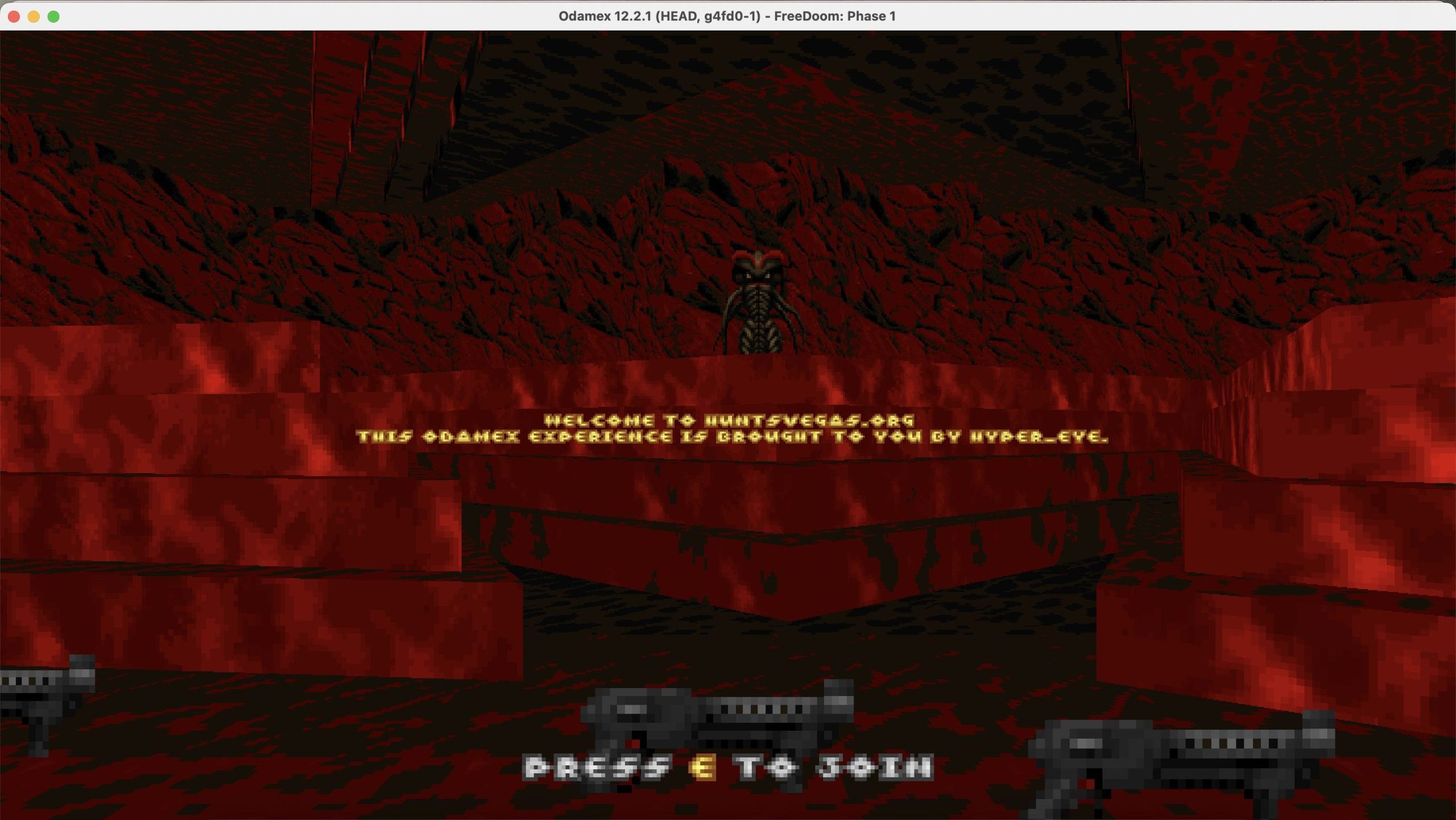
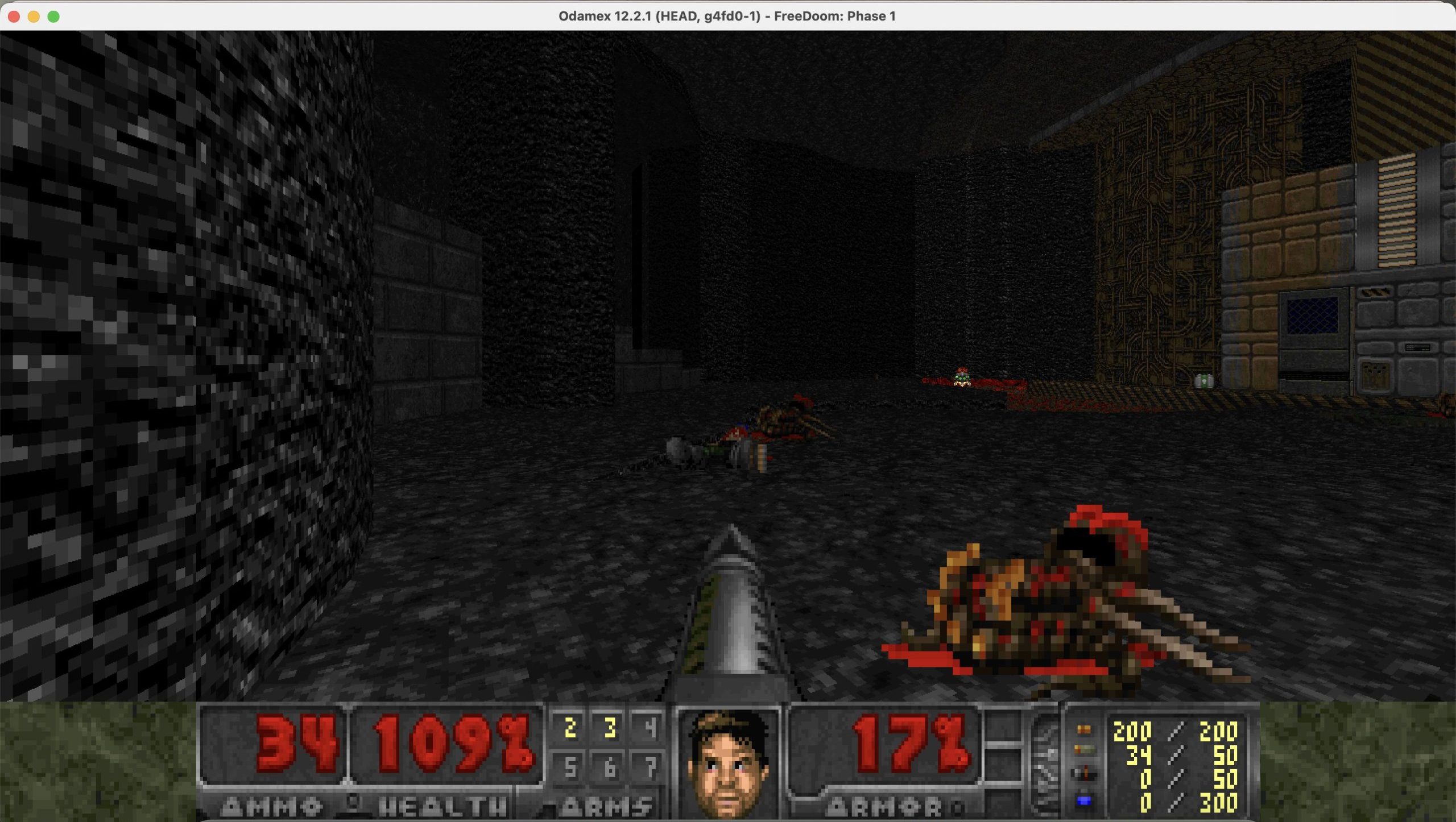
Use Odalaunch’s server browser to list available public servers. Filter by game mode, WAD, or player count. Double-click a server entry to connect. Ensure you have any required PWAD files the server specifies before connecting.
(Optional) Host a dedicated server
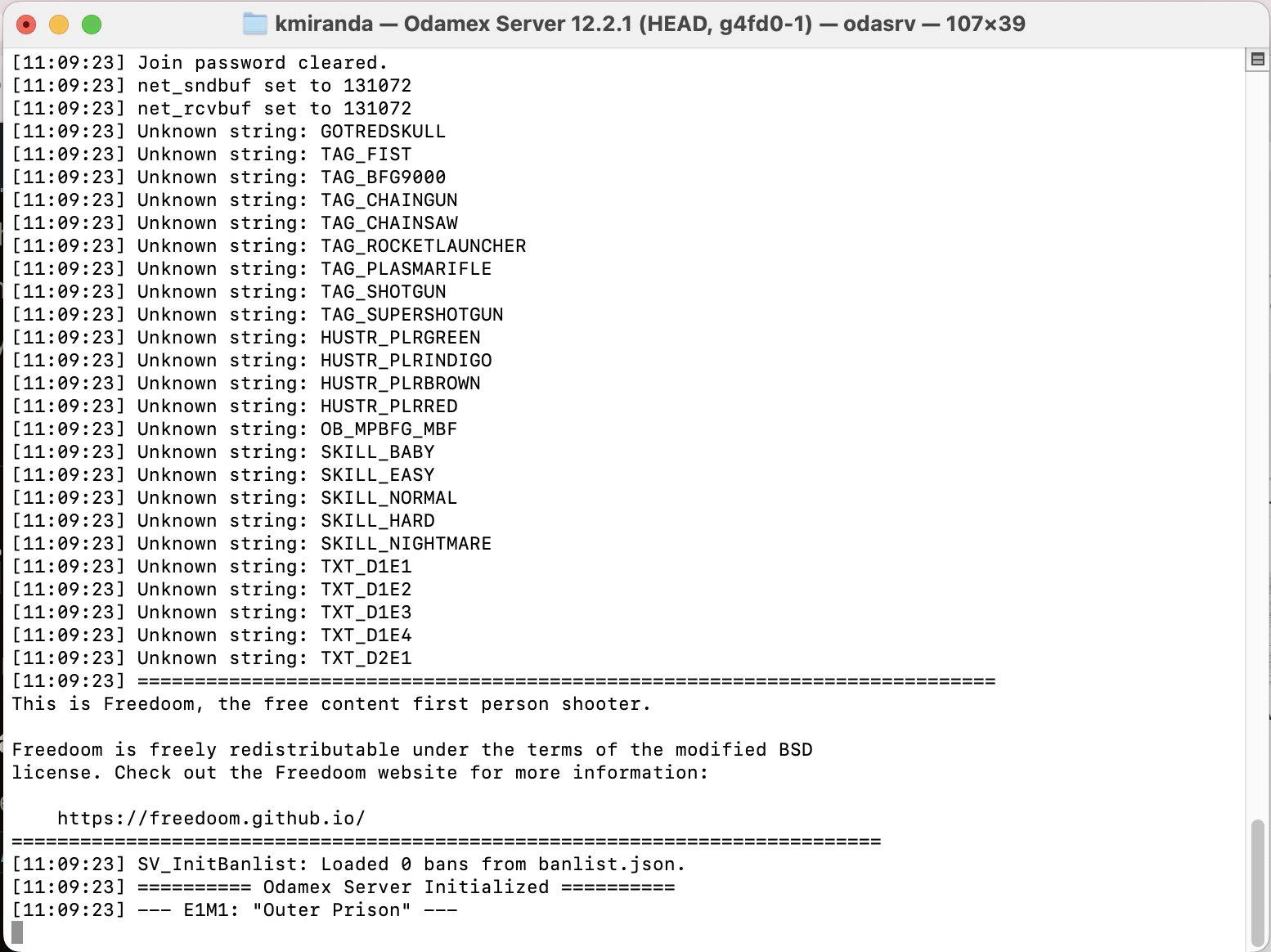
Run the dedicated server binary from the command line with a configuration file specifying your IWAD, optional PWADs, game mode, and network port. The server runs headlessly and clients can connect via its public IP address.

Odamex system requirements
Odamex vs other source ports
Need to pick between ports?
Short version: Odamex handles most needs. For the full comparison and our ranked list, see the dedicated pages.
Frequently asked questions
What is Odamex based on?
Odamex is based on CSDoom 0.62, a multiplayer-focused Doom engine modification originally created by Sergey Makovkin. CSDoom itself was derived from ZDoom 1.22 by Marisa Heit. This lineage gives Odamex its client–server networking architecture.
How many players can play on a single Odamex server?
The engine supports up to 255 players in a single session, as documented in the GitHub repository. In practice, competitive servers host far fewer players, but the ceiling is well beyond vanilla Doom’s four-player limit.
Which platforms does Odamex support?
Odamex provides official pre-built binaries for Windows, macOS (as universal binaries), and Linux (including a Flathub/Flatpak build). The source code is publicly available on GitHub for building on other operating systems.
Does Odamex require an IWAD?
Yes. As a Doom engine port, Odamex requires a legitimate Doom IWAD such as DOOM.WAD or DOOM2.WAD to run. The engine does not include id Software’s original game data.
What license is Odamex released under?
Odamex is released under the GNU General Public License v2.0 (GPL-2.0), as confirmed by the LICENSE file in the repository. This means the source code is publicly available and modifications must be distributed under the same terms.
What is new in Odamex 12.3.0?
The current stable release is Odamex 12.3.0 (released August 6, 2026). It is a minor version release with many bug fixes, feature additions, and performance improvements. Highlights include a new cvardocjson console command, a Server Details window in Odalaunch, mouse-driven menu navigation, stacked sector portals, several new ACS functions including client-side scripts, and numerous stability and rendering fixes.
How does Odamex differ from GZDoom for multiplayer?
Odamex was built from the ground up as a client–server multiplayer platform and uses a dedicated server model, whereas GZDoom is primarily a single-player hardware-renderer port descended from a much later ZDoom codebase. Odamex prioritizes classic online Doom gameplay with a software renderer; GZDoom prioritizes modern rendering, scripting (ZScript), and single-player modding.
Can I host my own Odamex server?
Yes. Each release package includes a dedicated server binary that runs headlessly without a graphical interface. Server operators configure it via a configuration file specifying the IWAD, optional PWADs, game mode, and network settings. Clients then connect using Odalaunch or by specifying the server address directly on the command line.
Sources
- EXT Odamex official website odamex.net
- EXT Odamex GitHub repository github.com
- EXT Odamex GitHub Releases github.com
- EXT Odamex — The Doom Wiki at DoomWiki.org doomwiki.org
- EXT Odamex LICENSE file (GPL-2.0) github.com